
New mayor meets with reporters
2021-05-20
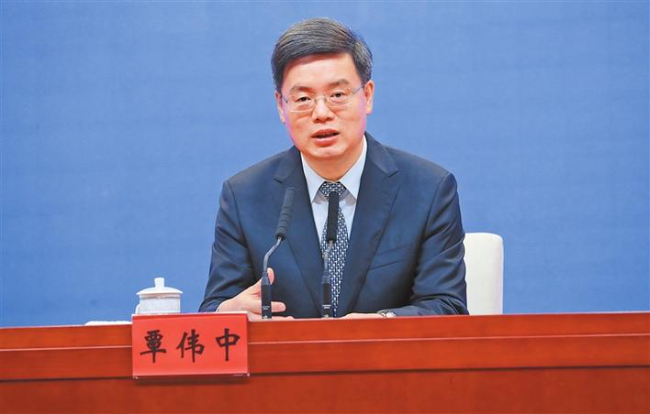
Qin Weizhong, the newly elected mayor of Shenzhen, speaks at a press conference at the Civic Center in Futian District after the conclusion of the First Session of the Seventh Shenzhen Municipal People’s Congress yesterday. (Shenzhen Daily)
Qin Weizhong, the newly elected mayor of Shenzhen, spoke face-to-face with reporters from different news media outlets to answer some of their questions on hot topics, such as green development, education, innovation-driven development, the construction of the Guangdong-Hong Kong-Macao Greater Bay Area (GBA) and urban governance at a press conference held at the Civic Center in Futian District yesterday.
More than 70 reporters from 27 different news media outlets, which include People’s Daily, CCTV, Xinhua News Agency, Economic Daily, Nanfang Daily, Shenzhen Special Zone Daily, Shenzhen Daily and Phoenix Satellite TV, participated in the conference.
Q: You’ve been working in Shenzhen for almost a month, and you’ve visited the city many times before. Have you walked around Shenzhen recently? Do you have any new impressions of the city?
A: Although I had quite a lot of meetings, I did visit some places, such as the Talent Park, the ecological corridor of the Dasha River and the Dongmen Pedestrian Street. I feel proud and deeply honored to be able to work in Shenzhen and to have become a Shenzhen citizen. At the same time, I also feel that I have a great responsibility and mission.
Shenzhen is not only a great city, but also a city that draws global attention. Shenzhen, only a border town 40 years ago, has now become an international and innovation-oriented city full of charm, vitality, dynamic, and innovative power.
I like this city very much. Shenzhen is a city like a rising star. Shenzhen’s GDP ranked fifth among Asian cities. The 7th national population census data have recently been published, and Shenzhen has a total of 17.56 million permanent residents, an increase of more than 7 million when compared with the 6th national population census.
Shenzhen is a beautiful and comfortable city with mountains and sea, good air quality and good ecological environment. It is a city of flowers, parks and forests.
Shenzhen is a young and fashionable city full of vitality. The average age of the permanent population is only 32.5 years old. Young people from all over the world have come here to pursue their dreams.
Shenzhen is also a vibrant innovation-driven city. It has gathered a large number of world-famous innovative enterprises, such as Huawei, Tencent and DJI. The city has all of the ingredients for innovation and entrepreneurship and is a fertile land for innovation and entrepreneurship.
Due to the rapid development of Shenzhen, there are inevitably going to be some problems that will need to be tackled, but these problems will be solved in a satisfactory way throughout the duration of the city’s development.
Q: In this year’s government work report, it was mentioned how the government will strive to deliver quality education to the satisfaction of the people. How will Shenzhen coordinate the balance of quantity and quality in the process of developing education?
A: The Shenzhen Municipal Committee of the Communist Party of China and the city government attach great importance to the development of education and investment in education.
Over the past five years, the government’s fiscal spending on improving people’s living standards, which covers nine major categories, has accounted for nearly 70 percent of the overall fiscal expenditure, and of that 70 percent, education expenditure accounted for a considerable proportion.
The number of school seats for basic education has increased by nearly 30 percent in the past five years. In addition to the rapid development of basic education, in that same time, the quantity and quality of higher education in Shenzhen has also been greatly improved.
We notice that there is still a measurable gap between Shenzhen’s educational development and the expectations of the public, and it needs to be reduced through hard work.
To enhance the quality of education in Shenzhen, I think we should focus on improving, optimizing and upgrading the “four systems,” which include the educational funding guarantee system, the principal and teacher development system, the education and teaching research system, and the monitoring supervisory and evaluation system.
Through relentless efforts, Shenzhen will comprehensively deliver education to the satisfaction of the people, strive to achieve the improvement of quantity and quality of basic education, and strive to achieve the high-quality development of all kinds of education, at all levels.
We are confident and determined to achieve the high-quality development of the city’s education, to meet the needs of the public, and to better support the construction of a global benchmark city.
Q: How will Shenzhen promote the construction of the Greater Bay Area? What efforts will the city make to achieve closer cooperation between Shenzhen and Hong Kong?
A: First of all, I would like to take this opportunity to thank Hong Kong for its long-term support and assistance in the development of Shenzhen.
In recent years, cooperation between Shenzhen and Hong Kong has become closer, which has greatly promoted the combined development of the two cities. For instance, earlier this year, Shenzhen introduced 18 measures for facilitating better study, employment, entrepreneurship and life for Hong Kong and Macao residents in Shenzhen.
Hong Kong’s service industry is rather developed. In terms of cooperation in the service industry, the Qianhai Shenzhen-Hong Kong Modern Service Industry Cooperation Zone has gathered more than 11,000 Hong Kong enterprises, and over 10 categories of professionals from Hong Kong, including accountants, lawyers and architects, can directly practice in Qianhai.
Hong Kong also has a number of internationally renowned universities with strong scientific research capacities. In terms of scientific and technological innovation, the two sides have also successfully carried out projects with in-depth cooperation. At present, there have been some breakthroughs in cross-border transfer of scientific research funds and scientific research samples at the Shenzhen-Hong Kong Science and Technology Innovation Cooperation Zone.
Next, Shenzhen will be actively promoting the construction of the GBA, strengthening the connection of infrastructure and rule mechanism and enhancing the market integration between Shenzhen, Hong Kong and Macao.
Q: What will Shenzhen do to promote peak CO2 emissions and carbon neutrality?
A: Over the past few years, Shenzhen has made great efforts to control and prevent pollution and has seen historical progress in the ecological protection of the environment. Shenzhen has taken the lead among big cities in the country in terms of air quality. Shenzhen also has seen visible progress in water environment; the water quality of the Maozhou River and Dasha River has been greatly improved. Shenzhen is the only sub-provincial city in the country to win the honor of model cities and counties for the construction of an ecologically friendly civilization. However, Shenzhen still has some room for improvement when compared to international advanced levels.
At the same time, we should begin making full use of carbon peak and neutrality goals to push forward changes in production and lifestyle so as to promote green transformation of economic and social development. Shenzhen will work out plans based on requirements in order to play a key role in achieving the goals of carbon emission peak and carbon neutrality.
Q: As a city of innovation, how will Shenzhen further promote innovative development and take the responsibility in realizing the country’s self-reliance and self-improvement in science and technology?
A: Shenzhen comes out on top, in terms of innovation capability, based on rankings released by institutions at home and abroad. According to the 2020 edition of the Global Innovation Index by World Intellectual Property Organization, Shenzhen-Hong Kong-Guangzhou science and technology clusters ranked second. However, Shenzhen still faces many challenges in the process of innovation, especially in fundamental research and applied basic research. We are still lagging behind a few other cities in the country and around the world in terms of our capabilities in these two aspects.
Shenzhen will enhance the building of a comprehensive innovation ecosystem and encourage leading enterprises to strengthen basic research. Shenzhen will also give more financial support for fundamental research and applied basic research, and encourage leading companies to play a bigger role in this regard.
Q: How will Shenzhen further improve modernization of urban governance?
A: Shenzhen attaches great importance to the modernization of urban governance and is striving to blaze a governance trail suitable for the metropolis it is. The modernization of urban governance of the metropolis can further developed in three aspects. These three are planning, construction and management.
We should first have high-level urban planning. The city has drafted plans for the optimization of land use structure so as to ensure the supply of land for industries, transport, public services and many others. Secondly, we should use high standards in building a high-quality city by making full use of technologies and new materials.
Finally, we should make management ruled by law, more meticulous and smarter by making full of technologies so as to make our city safer, cleaner and more beautiful for its citizens. (Shenzhen Daily)